Biometric Access Control for Austin's High Security Doors
Fingerprint and facial recognition entry for the doors where you need to know it was that person, not just their card. The highest level of certainty available on a commercial door.
The Basics
The Credential Nobody Can Hand Over
Every other form of access control verifies a thing. A code can be shared. A card or fob can be lent, lost or copied. In both cases the system knows which credential opened the door, and assumes the right person was holding it.
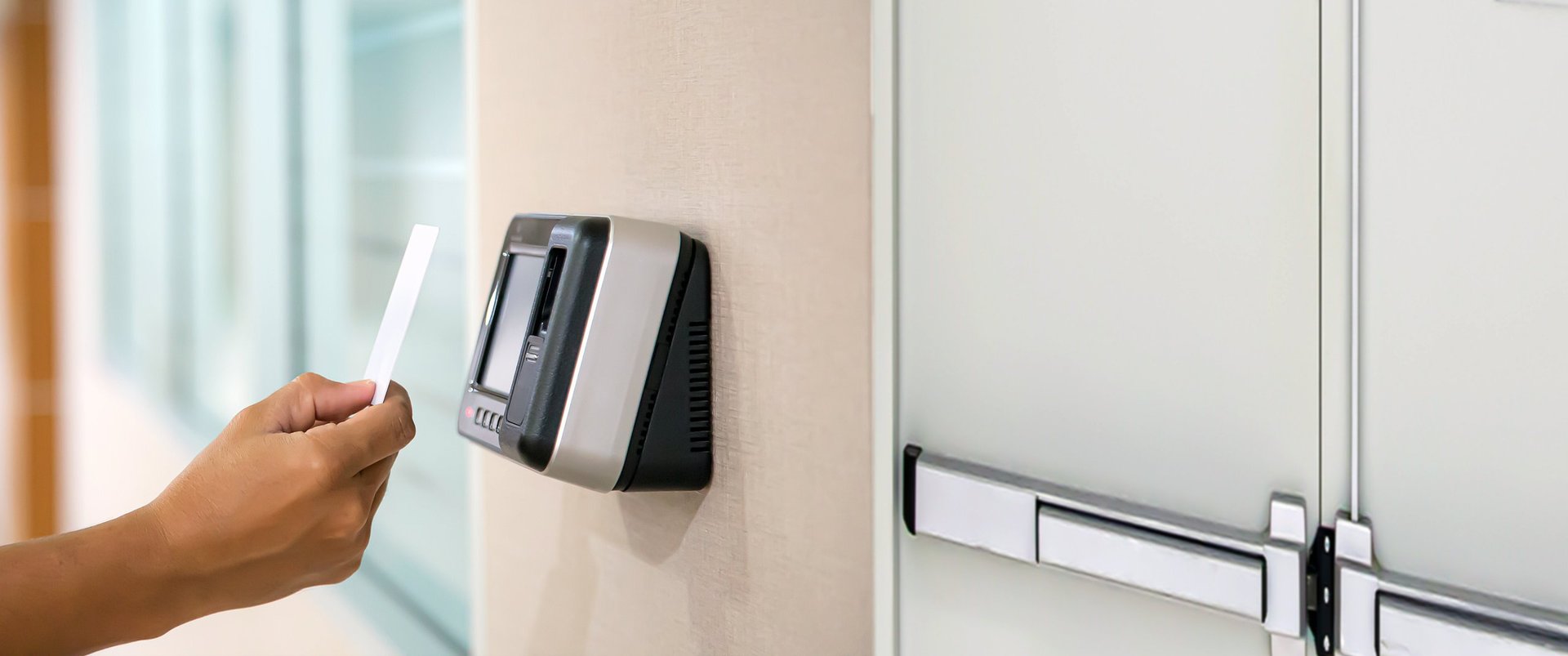
Biometric readers verify the person. A fingerprint, a face or an iris pattern is checked against an enrolled template, and only a match releases the door. There is nothing to pass to a colleague, nothing to leave in a jacket, and nothing to duplicate at a kiosk.
That certainty is the entire point, and it is why biometrics belong on a small number of specific doors rather than on every door in a building.
What the Reader Checks
Fingerprint, Facial and Iris Recognition
Fingerprint Readers
The most common and most affordable option. Fast, well understood, and suited to most indoor commercial doors. Reading can be affected by wet, dirty or heavily worn hands, which matters in some working environments.
Facial Recognition
Nothing to touch, which suits clean rooms, food environments and high-traffic doors where people are carrying things. Positioning and lighting affect performance, so mounting matters more than it does with a fingerprint reader.
Iris Recognition
The most precise of the three and the least affected by the condition of someone's hands. Typically reserved for the highest security doors, because it costs more and takes longer to enroll people.
Choosing the Right Door
Where Biometrics Earn Their Place
Biometric readers cost more than cards or keypads, take longer to enroll people onto, and give you a slower door. On a main entrance used by two hundred people a day, that is the wrong trade. On a specific room where credential sharing is the actual risk, it is exactly the right one.
Controlled Substances and High Value Stock
Rooms where a shared card is the weak point, and where you need certainty about who was in there rather than which credential was used.
Server Rooms and Records
A small number of authorized people, a high consequence if the wrong person gets in, and often a requirement to prove who had access.
Cash Handling and Safes
Doors where a lent credential defeats the whole arrangement, and where an audit trail needs to be about people rather than cards.
Layered Alongside Cards
Many buildings use credentials on the perimeter and biometrics on two or three interior doors. Convenience where it belongs, certainty where it matters.
Before You Commit
Biometric Data Comes With Obligations
Texas has a specific law covering the capture of biometric identifiers for commercial purposes, and it requires informed consent before you collect them. Fingerprints and facial data are not the same as issuing a card, and how you collect, store and eventually delete them is a decision your business owns.
We are access control specialists, not attorneys, so we will not tell you what your obligations are. What we will do is tell you honestly, before you spend anything, that this is a question worth answering with your own legal advice rather than after the readers are on the wall. We can also tell you how a given system stores its templates, which is usually the first thing your advisor will ask.
For a lot of businesses the answer is that biometrics are right for two doors and cards are right for the rest. That is a perfectly good outcome and we will say so.
Common Questions
Biometric Access Control FAQs
For the specific problem of credential sharing, yes. A card can be lent, lost or copied, and the system only knows which card was used. A fingerprint has to be presented by the person it belongs to. That is the advantage, and it is why biometrics suit specific high consequence doors rather than every door in a building.
Most commercial systems store a mathematical template derived from the fingerprint rather than an image of it, and the template cannot be reversed back into a usable print. Systems vary in how and where they store that data, which is one of the things we check and explain before you commit to a particular platform.
Texas law covers the capture of biometric identifiers for commercial purposes and includes an informed consent requirement. How that applies to your business is a legal question rather than a technical one, and it is worth answering with your own legal advice before installation rather than after.
Enrollment quality, worn or damaged fingertips and wet or dirty hands all affect reading. Good systems allow multiple enrolled fingers per person and a fallback credential such as a card or a code for the small number of people who consistently read poorly. We set that up as part of the install rather than leaving anyone locked out.
It depends on the technology, how many doors, how many people need enrolling, the locking hardware and whether it ties into an existing system. Biometric readers cost more than cards or keypads, which is why we usually recommend them on specific doors rather than everywhere. We quote after a free site audit, with clear pricing and no hidden fees.
"He displayed excellent communication on the process and transparent pricing. It was clear how dedicated he was to high quality work and customer satisfaction. We trust him deeply with the security of our business, families, staff, and students!"
Alma Flores-Perez, Google review
Ready to Secure Your Doors?
Tell us about your property and what you need. We will put together a clear, no-obligation quote. There is no charge and no pressure.